Fairy tales, or folklore, are sometimes invoked for a game’s level or for one of its characters. Their being used as the entire influence for or feel of a game is a much rarer occurrence, at least in high quality titles.
When it comes to games, classic children’s tales are most prevalent in the budget software section of local department stores. They are resigned to a fate of being cheaply or even freely acquired, their pre-established stories used with the same reasoning and quality that public domain music is. They represent a way to get development done quickly, and for a quick profit (hopefully). These titles are often directed at young children in an educational format, and very few of them are good by the standards of the discerning gamer.
This isn’t to say that all storybook-inspired games are cash grabs or that interesting adaptations have not been created. American McGee’s most well received creations, 2000’s Alice and the episodic Grimm, are both created in the likeness of their respective literature. Disney and Square’s money-printing powerhouse Kingdom Hearts, a series that has sold over 10 million copies across its entries, uses Disney-fied (should be a word – Ed.) fairytale characters within integral plot developments, and to much critical acclaim.
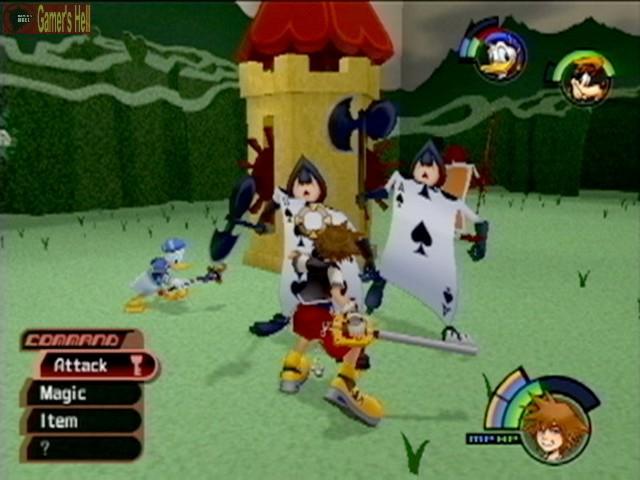
Many derided the idea of Kingdom Hearts, but it has found strong commercial success.
American McGee’s games and the Kingdom Hearts franchise represent the two extremes of fairy tale adaptations. In one corner you have the incredibly marketable, colorful and romanticized heroes and princesses of Disney. This is the side where the good guys always overcome the odds, everybody gets to live vicariously though royalty, and you can get an associated plastic toy in a fast-food meal. I’m surprised that this type of adaptation hasn’t been mined for all its worth yet. That not a single developer has churned out a simple platformer with a cutesy animated character jumping from her place to Grandma’s, having to collect all the bits from her picnic basket while avoiding the Wolf, is perplexing. If it was released on Wii, or given easy achievements for the 360, it would at the very least turn a profit. Considering the success of Kingdom Hearts, it’s easy to see how traditional folklore can be mapped onto an existing formula to enhance it. Square’s own recipe for success was to take one Square-style role-playing game, mix in the already available emotional attachment present in Disney’s versions of classic fairy tales, and then swim in the money like Scrooge McDuck.
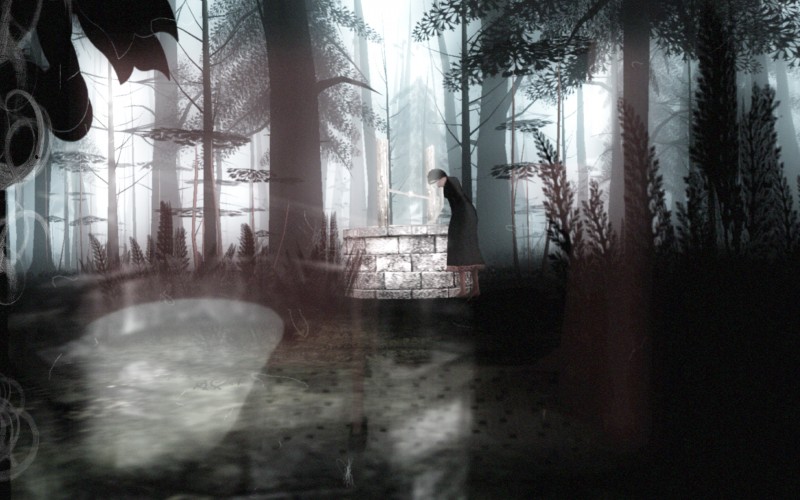
In the other corner is American McGee’s Alice and Grimm, and The Path. This is where a classic is taken and distorted – fractured, if you will – and turned into a neo-gothic noir-morality play of some sort. It could be the fairly hollow dark-for-dark’s-sake of Alice, which was really just a traditional platformer with a paint job that made it seem like it owned every Siouxsie and the Banshees album. Or it could be the dark-for-arts’-sake of The Path, the theme of which actually applied to its unique and decidedly nontraditional gameplay mechanics, and helped to make the game as deep and entertaining as it proved to be.
While the darker themed, mature takes on fairy tales might not have as much appeal to the mainstream of gaming culture, they give more room for engaging plots and creative liberties. Also, they are generally closer to the source material than the versions that tend to be made into stuffed animals. Some of the original fairytales made famous in the Brothers Grimm’s works, and especially the original Little Red Riding Hood as told by Charles Perrault, are more sinister than anything Tim Burton could think of when ‘re-imagining’ tales in a form more palpable to the Hot Topic crowd. The Path may not follow Perrault’s version of the folk tale, but its themes are more in line with the bleak morality of the story than any homogenized Disney variation that ends with Red not being tricked into cannibalizing her own grandmother. Instead, The Path focuses on growing up and adhering to conventional social expectations, and it does it in an entirely unconventional way. While The Path offers up an incredible example of what video games can do from an artistic standpoint, it also provides a glowing example of what video games can do with classic tales as thematic inspiration.
A creative developer isn’t cornered into using only American and European folklore as foundation. Many games have already seen enormous success by borrowing ideas and stories from other cultures too. For example, Viking: Battle for Asgard was a fun, albeit repetitive, glimpse at viking myths and legends. God of War took Greek mythos and showed how a game can follow history and legend fairly accurately without being limited in its storytelling. The appropriately titled Folklore, a recent action-adventure game based loosely on Celtic traditions, has been garnering some strong word of mouth. Many Japanese developers already build on their culture’s vast wealth of folklore, most notably in the form of Okami, and have great success with it. Sun Wukong, the most well known character in Chinese literature, is represented in the SonSon series and is even a loose influence of the titular character in the iconic Alex Kidd games.
The past may be the past, but with the eclectic hack-and-slash Fairytale Fights on the horizon, and a seemingly never-ending inundation of Kingdom Hearts titles, it’s clear that some companies still see potential in games drawing influence from folklore. Games about the gods have already proven to be both critically and commercially successful, as God of War‘s immense popularity can attest too. Whether or not this popularity can transfer over to a more traditional folklore-based game comes down entirely to the developers. As gamers taste continue to mature, these games will also mature in their storytelling. Video games have evolved from being pointless escapism for young children into a medium that can be held as an equal to movies. As an art form, video games can be used to analyze everything from history to politics in an intelligent and meaningful way. In short, fairy tales aren’t just for kids anymore.
”
